Tied to the Mast
A few weeks ago I told my teenage daughter—for the fifth time—that she was not done with the dishes.
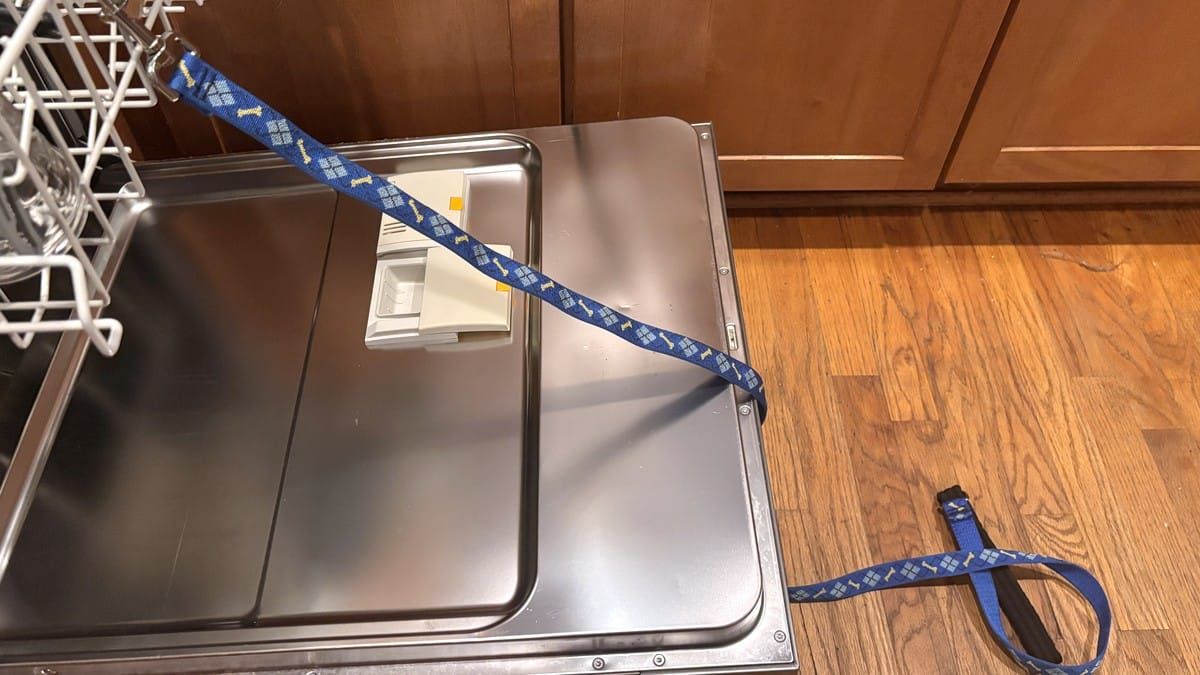
What I did next is not going to make it into a parenting book. I went and got a dog leash. I tied it around her waist and clipped the other end to the dishwasher drawer.
She giggled. She knew exactly what she was doing. And she knew exactly what I was doing, and why. She also stayed. Every time she drifted toward the door, the leash caught her—gently, physically—and reminded her that she was still in the kitchen, and the kitchen still had dirty dishes in it.
My daughter has ADHD. I had just spent five reminders being irritated at her for it.
I was annoyed at her for being me.
Nobody who believes in willpower invents a leash. If I thought focus were a matter of trying harder, I would have said “focus” a sixth time and gone to bed angry. I reached for a physical object because I have learned that a sixth reminder will not work.
The Odyssey is back in theaters this summer, and it has me thinking about quests.
The poem is not so much a journey as a series of fascinating interruptions connected by occasional boat rides.
Consider the record. Odysseus escapes the Cyclops cleanly. He has won. He is on the ship, out of range, safe—and he cannot resist shouting his name back across the water. His crew begs him to stop. He does it anyway. The Cyclops, who now has a name to work with, prays to his father Poseidon that this man lose every companion, come home late, in a stranger’s ship, to trouble in his own house.
Impulse control?
He gets a bag of winds from Aeolus and steers for nine days without allowing himself to sleep. On the tenth day, they are close enough to Ithaca to see people on the shore tending their fires. That is when he finally sleeps, and that is when the crew opens the bag.
I have seen this strategy fail before. It begins with, “I’ll just stay up all night and finish it.”
He stops at Circe’s for dinner and stays a year. He does not notice. His men have to tell him.
Time blindness?
He is warned not to linger among the dead and proceeds to interview approximately everyone.
Odysseus may well have invented the side quest.
And every man who sailed with him died.
The boat was crewed. Somebody was sailing it while he was down in the dark asking Achilles how he was holding up. The unglamorous, repetitive, load-bearing work was happening the entire time, and it was happening to other people.
Somebody kept watch. Somebody handled the sails. Somebody rowed.
Odysseus got the side quest. The crew carried him.
There is exactly one episode where he does better, and it is the Sirens.
Circe gives him the instructions: put wax in the crew’s ears, and if he wants to hear the song himself, they are to lash him to the mast. When he begs to be released, they are to tie him tighter. He does beg. He cannot be heard over the music, so he starts signaling with his eyebrows. Two of his men get up and bind him down harder before returning to their work.
It is the only time in the poem he plans for his own weakness in advance, and it is the only time it works.
I have a novel in progress. An idea for a dissertation. A real, full-time job. A catalog—not a list, a catalog—of side projects. All of that is genuinely mine, and I am good at it.
I also have taxes. Weekly bills. An exercise routine that exists mostly as a concept. For those, I have to invent something: a system, a trick, a timer, a rule, a leash.
My mast is structure. Not willpower. A calendar, a deadline, a form somebody else designed with a due date.
The trouble is that I am very good at building structures, and building one is more interesting than living inside one. A new system is a side quest with a spreadsheet. I can spend a satisfying week designing the thing that will finally make me pay the bills on time, and at the end of that week I will have a beautiful system and unpaid bills.
The structures that hold me are the ones I did not design.
School starts when school starts. Advent begins when Advent begins. The calendar the Church has been keeping for centuries does not adjust for how my week went, and it will not let me improve it.
Neither does the practice of regular prayer known as the Divine Office. Several times a day, monks, nuns, priests, deacons, and laypeople like me stop what they are doing and return to prayer. The hour arrives whether we are ready or not. My work may be unfinished. My mind may be elsewhere. It does not matter. The hour has arrived, and I stop and tend to my prayers.
And nearly every time, the prayer begins with an admission:
O God, come to my assistance. O Lord, make haste to help me.
The structure assumes that I will wander. It does not wait for me to become prayerful, focused, or prepared. It interrupts me and brings me back.
It is also beautiful; that is no accident. Somebody worked out a long time ago that a structure has to be worth staying inside of.
Odysseus did not tie himself to that mast. He decided, while the music was still distant, who would hold the rope. Then he handed it over.
Odysseus is the reason there is a story, and Odysseus is the reason there is no crew. The curiosity that gets him past the Cyclops is the curiosity that gets everyone killed, and there is no version where you lose one and keep the other.
He is also the only one who makes it home.
In his telling, each disaster simply happened to him.
The crew paid the price.
The point is not merely to make it home. The point is to make it home with the crew.
My daughter was diagnosed before I was. After she understood what it meant, she turned to me, laughed, and said, “Someone needs to test my mom.”
She was right. I was diagnosed with ADHD in middle age, and it surprised no one but me.
I cannot make myself into someone who does not wander. But once I know, ignorance is no longer an excuse.
As a reminder, I keep a print hanging in my laundry room with a quotation from Kahlil Gibran:
Work is love made visible.
While I despise doing laundry, I do love my children. So often, love is the work that keeps everything else standing. I am the crew: the calendar, the timer, the reminder, until they can do it for themselves.
There will be dirty dishes tonight. And we all know where the leash is.