What Mary Knew
Last week a man I have never met posted a question on LinkedIn that every digital analyst has half-wondered and nobody ever chases down. Why does a web session end after thirty minutes of inactivity?
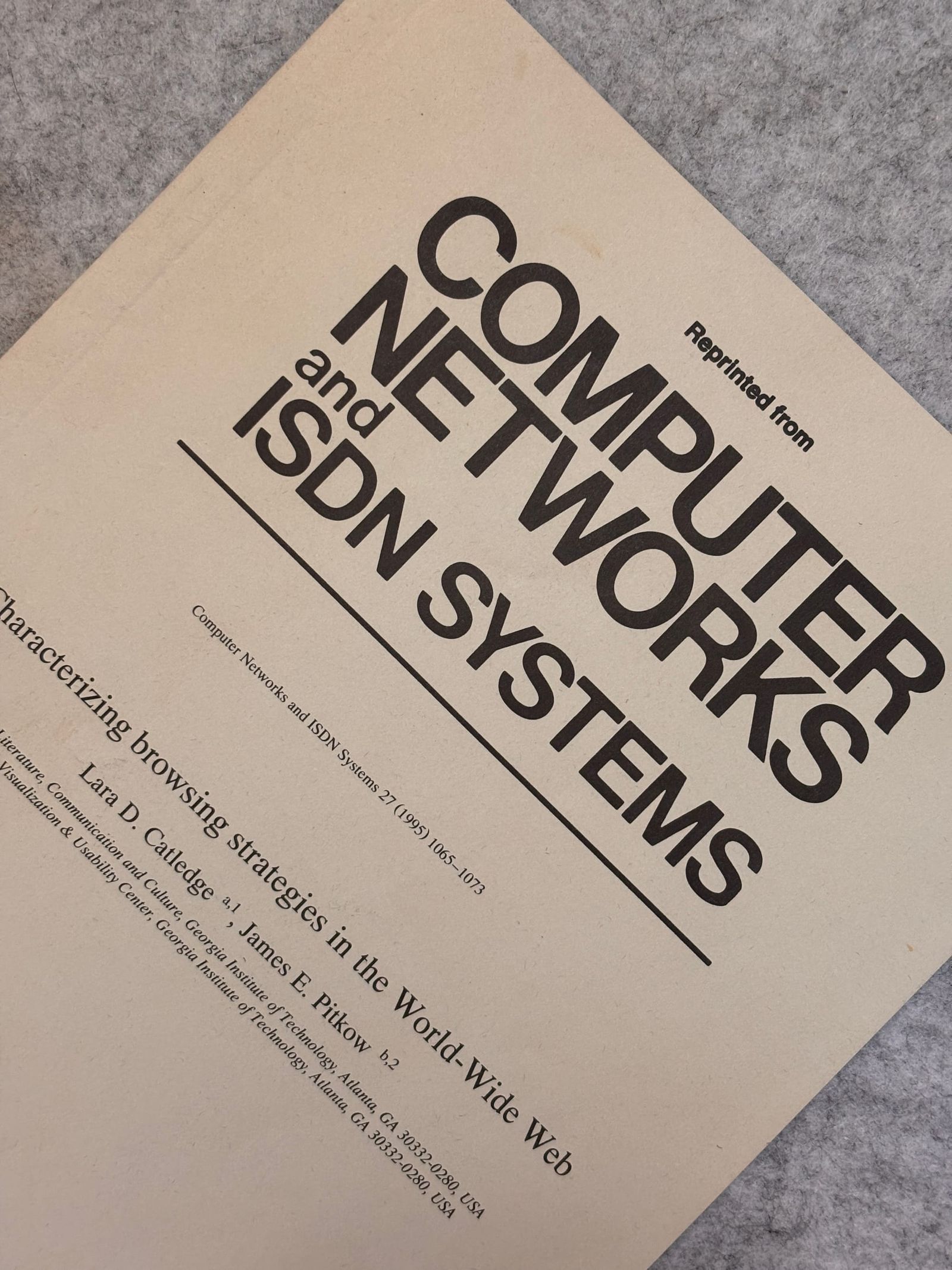
He assumed what most people assume—that somebody typed a placeholder into a spec decades ago, meant to come back to it, and never came back. So he went looking. The trail ran back to a 1995 paper called “Characterizing Browsing Strategies in the World-Wide Web,” by Catledge and Pitkow. He couldn’t get access to a copy. He said the maths behind the number looked dodgy, too.
Well. I’m that Catledge.
Jim Pitkow and I wrote that paper as graduate students at Georgia Tech, in the GVU Center, in 1994. Mosaic was about a year old. Nobody was sure yet what the World Wide Web was going to become, or whether it was going to become anything. Jim had gotten permission to install a browser that he had instrumented on the lab computers in the College of Computing. We traced the log files of one hundred and seven students, faculty and staff to see what people actually did—where they went, how often they hit Back, how quickly they gave up. We had masses of data and no idea what to do with it or what it meant.
Partway through the analysis we hit a housekeeping problem. People leave a browser open and wander off to lunch. If you are going to say anything at all about sessions, you have to decide where one ends. So we took the average gap between events, went out a stretch past it, and cut the log file at twenty-five and a half minutes.
That is two sentences in a methods section. It was a convenience. We needed to segment a log file, and that is the entire reason the number exists.
It is now in every analytics platform on earth, rounded up to thirty.
He was right about the arithmetic, too. Somebody has since rerun our sum on twelve months of modern data and gotten six different answers depending on where they decided to cut the tail off.
Reading all of this, it occurred to me that I hadn’t looked Jim up in a while. I did that periodically. His career had gone a different direction than mine and I liked watching where it went.
Jim died in July. He was fifty-six.
I am fifty-six.
I found out from a search result, standing in my kitchen, thirty-one years after we sat in the same lab arguing about log files.
You would think that a woman who has just spent a week staring at three decades of evidence that nobody can see anything coming would hold her own plans a little more loosely.
I do not. I would like a project plan. I would like to know who owns which deliverable. I would like, more than anything, to be told that I am going to be okay. I’d much rather have a five-year plan than five minutes of uncertainty.
It took me a long time to work out that I wasn’t doing any of that because I was arrogant. I was doing it because I was afraid.
I have been reading Spe Salvi, Benedict XVI’s encyclical on hope, for another project, and a sentence near the beginning stopped me cold. He has just said that what distinguishes Christians is that they have a future—not that they know any of the details of it, but that they know their life “will not end in emptiness.” Then he adds:
“Only when the future is certain as a positive reality does it become possible to live the present as well.”
Benedict XVI, Spe Salvi, §2
That is not the trade I keep wanting to make. I want the details. I have always wanted the details. Benedict’s claim is that the details were never on offer to anyone and are not what makes the difference anyway.
Mary got the smallest possible quantity of information. Gabriel told her what would happen to her body and told her nothing else. Not Bethlehem, not Egypt, not thirty years of ordinary hidden life, not Calvary. She asked one clarifying question. How? Gabriel’s answer explained nothing. She still said yes.
Gabriel would have had a considerably harder time with me.
That is what she knew. Not what would happen. That it would not come to nothing.
Well. In the end, I think it’s fair to say that Mary was not okay.
She watched her son executed. Christian hope has never required anybody to pretend otherwise, and it doesn’t require it now, about a fifty-six-year-old man who should have had thirty more years.
Saturday is the Assumption. It is the only Marian feast that stands at the far end of her life and looks back down the whole length of it—the view she was never given, and the one Jim and I didn’t have in 1994 either, when we were making up a number to get a paper finished.
I still can’t see thirty-one years ahead. Or thirty-one days.
Apparently that was never the assignment.
She was about fourteen. The paintings came later, with the gold leaf and the lily and the light coming in at an angle. What there was, that night, was a girl alone in a room in a town of a few hundred people, and an angel, and no details at all.
She said yes.